Well, I am a proud member of the class of 2001. I know there's a bunch of you out there right now. Yeah. Um which means this is my 25th reunion uh weekend as well. Uh so I'm looking forward to participating uh in all the events this weekend like you. Um that's not however why I'm here. I am here in my capacity as a lecturer at the GSP. Uh after a 25ish year career in private equity, mostly as a partner with Helman and Freebin, I uh joined
the faculty here at the GSB last year. Uh I took over and and stepped into some giant shoes. I'm teaching Jack McDonald's class. Uh Jack literally it is intimidating, but it's also an amazing tale. the, you know, the community of support and such is is phenomenal. Including, by the way, Jack's uh widow Melody is in every class. She still comes to every class and it that's really a a point of just how much of a family uh it really is uh in Jack's community. Um so
I'm here as part of that and as part of that role, I'm also helping with the initiative investing. So thank you all for coming and and and hearing a little bit about that. I want to do two things here this morning. um in addition to leave some time for Q&A which is one I'm going to go through a few slides just on what is the initiative for investing what is investing at the GSP and where are we going with all this and then I want to
turn it over to our panel and I'll I'll lead a panel discussion here with uh three of my colleagues from the the GSP Henry GA Singer and Scott Brady to try and bring it all to life uh for you. So, uh, with that, given we've got 50 minutes and given I want to leave some time for Q&A, let me just, uh, get into it. So, the initiative for investing is relatively new at the GSP. Some of you have probably heard of it, some of you probably
haven't, but let me just start by saying investing is for sure not new to the GSB. In fact, it's deeply embedded in uh, the overall curriculum and uh, culture of the GSB. 20% of our students today come from investing backgrounds. More than 90% of students take an investing class of some form or fashion. I think it's actually part of the course. It's probably 100 if I'm honest. Um and then more than 33% of people actually go into investing uh over time. And if you go and
look at some of the labels uh the the logos of uh some late stage companies, this is public and private equity. We've got founders. We've got uh meaningful uh managing partners of all of these uh firms here who've really not just uh grown great firms but really had a big influence on asset management generally. And the initiative does include venture as well. And you know to say that the GSB has played a role in the venture community is probably the biggest understatement I'll make here today.
Uh when you think about uh these firms and it may look like I just pasted a bunch of colored squares up there. Uh these are actually the logos of of VC firms which maybe we can ask Scott and David around around uh those but uh you know Kleiner Perkins, Coastal Ventures, Excel, Benchmark, Andre Horowitz. I mean these are all uh firms filled with GSP grads that are literally uh changing the world. It goes back even further. You know, you go back to some of the the
the research, some of the the academic roots of the GSB, and you'll see names like Bill Sharp, Myron Scholes, former Dean Mike Spence, who've all played a really meaningful role in influencing the intellectual landscape around investing. Um, has anyone received stock options? Maybe a few. You can thank Myron Scholes for that. I'm just kidding. But anyone who's actually expensed stock options on their P&L can thank Myron Scholes for that as part of the Black Scholes piece. What people probably don't realize is how much the investing
landscape of the GSP has changed um since many of you were here. Uh there really has been an explosion of classes uh that have come when I was here. So this is you know that 99 to01 period investing at the GSB was Jack's class. It's a little bit of exaggeration, but that that's really what what I thought of. And you'll see here we literally have dozens of classes taught by great professors, great practitioners, uh, leading real practical and frontline judgment uh, formulation. I mean, you can
see how who wouldn't like to take a class from two a two partners from TA and Anne Byer around what a good business is, you know, Buffett style investing. How about Hano Lustig and the CIO of the Huelet Foundation talking about institutional investing. Um John Mccslet's a great investor. I mean, I'd love to take uh Mike Harmon, who's a former uh Oak Tree Partners restructuring class. Not because any of my companies need restructuring, but you know, for a friend. Um and it's just a great landscape.
And of course, Jack's class is still part of that land landscape uh here after I think it's now been over 65 years that this class has been taught and it's still about fundamental investing. You know, Jack was a real uh innovator when he brought that to the GSB in the 60s. Uh and the class is still growing strong. The basic uh pedagogy of Jack's class remains which is we bring in 20 amazing now full GSB alum uh investors who come in and talk about their craft.
They talk about how do they assess risks uh on the front lines? How do they make judgments? Uh how do they build firms? Uh and it's really that mosaic that we then have added to which is uh some teaching notes and some other curriculum that really gets to the heart of ultimately when Warren Buffett says buy wonderful businesses at fair like what does that actually mean and how do you actually do that and that's really the kind of the curriculum. Uh you can see the the
parts of that this never has been a class really just for investors. Um, it's really Jack stressed this and we really believe this that even if you don't want to be Warren Buffett or you don't want to be another type of investor, this is an super important leadership class. Um, we talk about judgments in uncertain worlds, allocating scarce capital as really the role of the investor. I think that applies to anyone who's a leader uh in business uh making decisions in uncertain times. You know, Buffett's
got a quote that I think really speaks to this, which is, you know, I'm a a better investor because I'm a businessman and a better businessman uh because I'm an investor. And that's something that we we fully believe uh and it's really part of why the initiative investing is uh is coming forward. Despite all of that, investing's always been the red-headed stepchild of entrepreneurialism at the the GSP. Um, you know, we've had great firms that have been founded, but it just hasn't had the precedence. When
people think about the GSB, it's entrepreneurship entrepreneurship entrepreneurship. And and I don't want to take any of that away. And frankly, if you look at some of the best businesses that have been built out of the GSP, a lot of those are investing firms. And so, I think these these approaches come handinand glove. Jack's class. Anyone know what the formal name of Jack's class is? No. investment management and entrepreneurial finance and it really does play into this whole theme of entrepreneurship actually dovetales into investing in
a very meaningful way. So enter the initiative for investing um and I'm very pleased to say this initiative will become a center in February of of 2027. It'll become one of the three big pillars of the GSP along with CES uh and the leadership institute. And with that, we'll be looking to continue to educate, train the next generation of leaders. We'll be looking to make connections. The the alumni community here is such a big part of Jack's class as you all know, but I think really,
especially in investing where we think of it as sort of a seven-year apprenticeship, that mentorship from a broader community is a huge part of it. And then obviously thought leadership uh that comes with being part of the Stanford We'll rely on the three big pillars of the GSB for that. And as I mentioned, you know, students, uh, alums and faculty and and the practitioners, uh, who are partnered in so many of these classes is is such an important part of that. One of the things we're
doing right now and and Henry will talk about because he's been a big part of this is re really thinking first principles about the curriculum framework. Um, you can see here just kind of the asset classes that we're covering in the initiative for investing. It's much broader than just public and private equity and and venture capital. And a surprising part of this may be to some is that we're we were for sure focused on the investment craft. You know, how do you make good investments? How
do you take good risk? But it's also the business of investing. Um, how do you form firms? How do you compensate talent? We'll talk to David Singer a little bit here who actually teaches a a class on compensating talent. So, both of those are really core pillars of the initiative. Here's the Cracker Jackack team uh that's really running the initiative on a day-to-day basis. Amit and Peter are the the faculty sponsors and leaders here. Gina and Judy really run the day-to-day. And then we've got uh
three investors in residence, which again, Henry will tell you a little bit about what that actually uh means here. Um and I'll just say, look, we're off to a great start. Uh last year was the first investor summit uh for the GSB. Uh we had a fabulous turnout filled this uh room and uh were overs subscribed. Lots of great investors coming in uh there. We've had a summer internship program for some emerging fund managers who might not otherwise be able to have GSP interns that has
been uh sponsored. And then a whole bunch of other work around kind of just planning uh for the initiative. And there's lots more to do. Uh we've got the second summit that's coming up in February uh of this year and a bunch of programming around emerging fund managers and family offices that people will see around that. We've got a new uh leaders in investing uh speaker series. Uh you know it used to be that uh the great investors, the Buffetts, the Mongers would come to Jack's
class. Given the broader curriculum, we're really expanding that uh now uh partly with a gift from TA Associates. We're bringing in some of the world's great investors to come probably once a month into the GSB to really talk about their craft. So, think about view from the top, but purely focused on investing. So, I'm really excited about that. And those will be interviewed by uh GSB alumni uh practitioners as well. So, you get a little twofer twofur in that. Uh, and then I want to get
to our panel and so I'm just going to really put this up and not really speak to it, but um I would just say if any of what I've said interests you, come on in. The water's warm. the the alumni uh community is such an essential part of everything we do at the GSP but as I said more so uh even with uh the investing community and as someone who's relatively recent into the community here I would just say it's also amazingly fun you know the
energy that you're experiencing this weekend actually at least in my uh experience does not dissipate uh the intellectual rigor of this place and frankly the students are pretty smart and force you to be on your toes. So, it's actually been amazingly generative to me for my own investment thinking to come back to first principles. You know, it's that what's the med school adage? See one, do one, teach one. That actually really is part of the the learning process in my my experience here. Um, so with
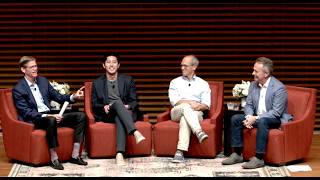
that, let me uh pause there. Uh we are going to leave time at the end for questions. So, I think we'll just jump right into the panel uh now uh and then hopefully uh leave a bunch of time at the end for for questions. take my seat for this. Okay. Um well, let me start out by just giving a quick uh intro of my fellow uh panelists. Uh here first of all, thank you all for joining us. Um here to my left, we have Henry Gao.
as uh you saw Henry's an investor in residence at the initiative for investing and actually a current current student still. He already completed his MBA but is finishing up his MA in education and so he's going to speak a little bit to the student experience. Uh next to Henry is David Singer who's a lecturer here at the GSB as well uh in his day job I guess is maybe the right way to put it. He's the managing partner of Maverick Ventures. He's a founder and former
CEO of three healthcare companies and a member of the Midas list. Pretty good f uh person to be learning from. And then if anyone was here for AI, you've already met Scott. Uh and what I'm going to tell you uh in my blurb here is not going to do Scott nearly justice, but uh Scott is a lecturer at the GSB. He's the faculty adviser for AI at GSB's Applied AI Initiative. Did I get that right? and he's a founding partner of Innovation Endeavor. So, another venture
capitalist. So, we're going to get I think an interesting venture capital conversation going here between Scott and David. And he's a founder and former CEO of multiple technology companies. And I'll just say this is the quality of uh faculty that we've got at the GSP right now and it's really uh amazing to be part of that community, but also I think for the students in learning. Um so, Henry, let me start with you here. um you have a unique perspective as part of the initiative and
and doing some of the curricular work uh but also as a student. Um let me ask you to put your student hat on first uh and let me ask you a question that I think probably you hear a lot from folks which is as an investor you you were at Goldman and then at TPG before coming to the GCP. Why come to business school? Why come to Stanford at this point? what what is the value that uh you thought you would get out of the GSP?
>> Yeah. Um thank you Eric. Great to be here. Uh it's a great question. I think uh the golf course definitely played a role in uh convincing me to come here. >> You forget this. This is the generation where that actually really >> sorry for taking up your tea times. Um but I'll be candid. I think for me it wasn't like a perfectly thoughtout like reason. Uh, and it really came down to the people at GSV, I think. Um, I remember back in college, I was
somewhat anti-b businessiness school. I didn't really see the point. I was in a career that didn't need business school to progress. Um, but I think really as I met more alumni from GSB, um, especially at my old firm at TPG, um, great shout out to David Trillo, Peter McGuan, Andy Doyle, like all alumni of the GSB. Uh, I think that really convinced me like it's a really special cohort of folks um who have great careers but also just like genuinely like interesting and nice people outside
of work. Um, so I think it was like kind of like an emotional decision is like I I want to be part of this cohort and I was just also very convinced that I think by by meeting these people being on this journey with you guys uh I'm really going to like create a lot of variance and broaden like the fan of outcome for my career and for my life and to me that was exciting and um that's why I came here. >> Yeah, spoken like
a true investor. >> And was it worth it? >> Uh yeah, definitely. Um I cannot promise you that my handicap like incre improved like meaningfully but uh it was definitely worth it. Um, I think back it was pretty silly for me to hesitate. Like yes, there's a little bit of FOMO about missing out on interesting transactions like opportunities in AI, but uh I do think like especially especially in times of change. I think there's actually a lot of value in stepping aside and like think and
kind of see more of the forest and the trees. Uh, and I think that's kind of like really what I did. I think for me it really came down to three things that uh I think collectively really helped me clarify like what I want to do like my next steps in my career and my life. I think uh I think number one is around like soft skills and like just emotional maturity. Um uh I came from like a pretty typical path like banking, private equity and
I think the GSB really pushed me out of the comfort zone like I applied and became an Arbuckle fellow that was not on the bingo card of a PE bro I guess. uh I uh I ran for student government, was elected to serve as the CFO for my class and I think those experiences really pushed me to uh uh to mature not as like a professional but also just as like a person. Um I think number two is around uh scratching that like operating and entrepreneurial
itch. Um like I knew I love investing but part of me is like okay what if I like operating more like can I give it a try? Uh and I think the GSB really gave me that opportunity like I helped uh actually a classmate uh run an education company that is has uh hundreds of millions of revenue globally. I was serving as the chief strategy officer uh as well as the country manager for Canada. So uh owning like a sales and marketing or like owning the
service delivery uh and really just like drinking from a fire hose like what is operating how to run a business. uh I loved it uh not as much as investing. Uh so I think that really confirmed my interest. It's like okay I still want to do investing but perhaps in a more uh entrepreneurial manner. Uh and I think last thing for me was uh it's kind of like an opportunity to reconnect with the world outside of the US. Like I came to the US from Canada
like over 10 years ago. Um and the GSB became like the perfect platform to reconnect internationally. like I went on a study trip to Ethiopia, Tanzania. Uh I did a GMIX internship in Japan. Uh I led the Stanford Chinua exchange program in Beijing. Uh and also with my friends, I red we designed uh the first ever Saudi Arabia and Oman study trip. Uh so I think without the GSB, it was really hard to kind of step out, kind of reconnect with um uh more of like
that international upbringing that I had. >> Yeah. Yeah. Terrific. Well, a lot of that that that resonates. Um, let me just then ask you to put your uh investor and residence hat on. Maybe first off explain what the role is uh for for everybody here and then touch on briefly if you wouldn't mind just kind of as you see it sitting in that chair. What are the top two or three priorities you see for the initiative? >> Yeah, absolutely. Uh so we kind of see the
initiative for investing also as like a startup like it's an experiment. We're trying to figure it out. Um, and the investor and residence role is a one-year fellowship uh that we really kind of see as a continuation of the investing education at the GSB. Uh, it has two parts. So, part one is to work and support Gina and the team on all the strategy and the programming of the initiative which will soon become a center as you guys know. Um so example projects will include uh
well sitting sitting here with you guys uh talking about the initiative uh like designing and planning like the investor summit in February. Uh we are reorganizing and coming up with like a curriculum framework to think about investing. Uh we also launched a uh research survey about AI's impact to investing. Uh and I think for me like um as I pursue my master in education like this opportunity to see what is it like to work in higher ed has been very special. Uh so that's part one
and part two is to really give a platform for um uh students or recent graduates who um want to pursue investing to really kind of stress test and build their thesis like for instance for instance uh during GSB I've actually built a thesis and strong conviction about like the Middle East and the GCC countries like the economics and social transformations like the region is becoming uh like a capital of capital uh its position in involving geopolitics Uh so the role has actually given me a lot
of um latitude and resources to uh not just like stress testing but actually like start operationalizing some of those ideas. So which has been really great >> um >> space that you wouldn't have had if you were working at TPG. >> Uh exactly. Yeah. Um well I do get paid more but like less latitude >> at TPG. >> Yeah. Um and yeah and I think in terms of priorities going forward I think there are two things that we're pretty excited about. I think one is um
I'm sure like Scott probably will talk about this like I remember at the GSV where I talk about we don't teach entrepreneurship like we study it and I think that's the exact same spirit we want to bring to the the center for investing is that um like I was a philosophy major in college I developed a passion for investing through this like small value investing club like at TBG I worked on control buyouts but also uh digital infrastructure like special situation credit and some growth equity
um and And I think I've always seen myself as like a student investing like how do I study the craft and how do I get better? Um and I think that's what something I want to bring to the center as well. It's like working in collaboration with faculty like uh alumni like students like really understand what does it take to be an effective investor across like strategies like asset classes market cycles environments. So I think that's one and I think the second one is about um
shedding more of a light on the business investing right like we are at a business school like investing is a beautiful craft is one of the most intellectually stimulating professions but it's also one of the most like opaque area of the of the business world. Um, so like even for me I think having worked on special projects like launching new products like strategies and acquiring other funds like coming to the GSB I was still very clueless about like uh fundraising operations like all of that stuff
that makes the the investing craft work. Um so uh putting more of a spotlight on the business and investing I think is another priority of ours. >> Yeah, that makes sense. Well, we're fortunate to have your perspective coming up into the curriculum development. So, thank you. Um, Scott, let me turn it to you next. David, I'm going to come back to you. Um, I think a lot of people uh when they think about investing at the GSB think about latestage investing. You know, the Jim Coulters,
the Bill Fords, the Mark Stods of the world. Not because VC is not an important part, but because I think people associate VC with the center uh for entrepreneurial studies uh here. But VC is important important part of this. And as I mentioned, VC's been a huge uh impact area for GSB alums. It's is sort of a crosslisting, if you will, now with with CES. But why don't we let me ask you a couple questions about uh the venture world, which is start with for a
young person who wants to be a venture capitalist? Um what is the right way to develop those capabilities? And maybe I'll even say as a late stage guys, what is the right capability to be a great venture capitalist? Uh and what does the GSP add to that? >> Yeah. So similar to Eric, I was very fortunate to fill the shoes of two legends from the GSP. So one of the second year classes I teach is one of the capstone entrepreneurial classes, formation of new ventures. That
was GPC and Chuck Holloway and I think you nailed it. Philosophically I think the GSB is different than most places. I don't think we set out to teach entrepreneurship. I think we we broadly study it and observe it and that's largely through the arc of a startup. It's really understanding the team formation ideiation execution scaling, all these fundamental inflective moments that you see in the entrepreneurial process. And I think, you know, in many of our classes, we observe that sort of uniquely through the eyes of
an entrepreneur. But I think from an investment perspective, you think about all the other really extraordinary things we do here. We teach the core foundations. Everything from cap tables to options to uh you know, governance. These are these are things that students are able to go deeply in and ruminate in. And I think really the intersection of how we think about both the entrepreneurial process, I teach in the center for entrepreneurial studies, but also think about the intersecting with the investment process. They're really the same
thing, looking at them from different sides. So being able to both observe what ideation and creation looks like and then being able to fund it is really just being ambidextrious. It's being able to do both. And I think what you'll see is many of our students actually do in fact experience both. Many of them like you know me will go off and be entrepreneurs. Um and when I you know I founded our firm with Eric Schmidt and Jorah Burman. All of us came from deep operating
backgrounds with an intense desire to support what we thought was the really disruptive process that was happening specifically around some of the areas of computer science like generative AI. And then, you know, I think if you look more broadly across the GSP, one of the other classes I teach is one of our new research classes, really equipping our students with the tools to be able to do firstparty research if for the purposes of creating a hypothesis about the future. And what I would argue to you
is as an investor, you're investing in what will be possible in the future. And I would also argue, you know, as a entrepreneur and as an investor, you really need to have that core hypothesis. So I think one of the benefits that GSB has is really the plurality of the different things we can offer students so that they can find their way through this journey both rooted in principles but also rooted deeply in observation and then having you know extraordinary people you know that come into
Eric's class come into my class that share their journeys in a way where we can allow our students to truly make original mistakes in what they do not recreate the mistakes of the past but stand on the shoulders of people that come before them. So I I think it's a unique environment and I think the pace of we're going to talk about this probably in a little bit. The pace of change is extraordinary and that means that our students have to be extraordinary and uniquely positioned
to be able to be relevant at this moment in time. >> Yeah, I love that man. I take away people empathy, you know, really investing is not a theory. It's you know what what needs to happen on a real operational level. Well, let's run with your comment there at the end, which is I think there's sea changes going on in the venture world. You're closer to it than I am, but obviously AI is part of that, but you know, later stage funding, bigger funding rounds, more
private time, private, all that sort of stuff. >> Does that change uh the formula for what people were teaching, what people need to know coming out? How do you see the the changes rippling through? Yeah, I think you you rightfully spoke to some of the legends of traditional private equity. I think the world is changing. I think uh it's very likely a few years from now you'll be talking about the legends of venture capitalists, but it's an aside. Um so let me give you what I
see in the market. I'll give you the data and I'll sort of give you the maybe the bare metal of what we're seeing. So one, the asset class has changed. Venture capital, the asset class has changed dramatically. In Q1 of this year, 73% of all venture capital was invested in five companies. Okay. So, you might ask why? Well, why is because, you know, when I first started uh the firm with Eric almost 17 years ago, we would underwrite opportunities believing that we could create billion-dollar outcomes.
Now, we see exemplars of trillion dollar outcomes. Think about someone like Anthropic. You know in 24 they had nine billion in revenue. Then they got to 30 plus billion. Then this year they got to 65 billion and targeting getting to 100 billion. They achieved revenue in three years that took someone like Salesforce 30 to achieve. And historically we've been competing for software budgets and now we think about labor. The world spends about a trillion dollars on software. We spend $60 billion on labor. So in fact
the opportunity is orders of magnitude larger than it was. If we look more broadly across venture capital last I think it was this year the amount of venture capital invested in early stage excluding the craziness I just spoke about the actual dollars have gone up by 41%. And the actual number of companies has gone down by 25%. So we're seeing both consensus but we're also seeing a huge amount of capital. And the question that everybody is playing with is are these the potential to be what
we would historically consider venture outcomes or are they the ability to deliver what is something unique now which is perhaps a trillion dollar outcome. And if you think about it uh you know we now have multiple private companies that are approaching that valuation. If you're a public market investor if you're in some cases a latestage private equity investor you would never participate in these. The other crazy statistic is that if you look at all of the capital in venture capital, this is from some I was
at a Stepstone conference, roughly 66% of all the capital has flown into 10 companies. So you're seeing an entirely new asset class that is attacking maybe the highest growth opportunity in the history of humanity, but they're doing it with a quantum of capital that's unprecedented and quite frankly with a type of company that has a voracious appetite for capital, but also a voracious appetite to build value. So having our students, you know, the other initiative I lead is the applied AI initiative. Having our students at
the intersection of where all of this is happening, I would just argue to you, uniquely positions them to not just be prepared, but to have a prepared mind around what's actually happening. And it's forced people that have been the industry for a long time to radically rethink how we think about this craft, how we think about this industry largely because we're dealing with outcomes that are orders of magnitude different than what we had considered previously. >> Yeah. I mean, I it strikes me listening to that
the importance of first principles. >> Yeah. >> You know, is is critical, which I think is what we're we're all about here. >> Uh well, David, I was going to turn to you to talk about the business of investing but >> that's a fascinating discussion. You're you're in that world. What do you want to maybe comment on? Are you seeing the same things? How does that impact your is >> Yeah, I I think that it's it's a perfect description of what we're we're seeing out there
and it's um it's exciting and it's problematic because it challenges some of our assumptions about everything. Um we are very early stage investors. So I I admit to that that being my lens. I I think the the it has certainly tactically changed the pace of deals, the dynamics of how much cash uh you need to deploy to like be important to the firm you're investing in even at the earlier stages. Um I I I I am not sure that the existence proof of a few trillion
dollar companies means that everyone is going to be a trillion dollar company. Right? I mean that the world's economy is only so big. Um and and the other thing that I don't really have an answer to, it's just an observation is that um entrepreneurship and these great ideas, they all start really small. like I I think um they start with a few people with a novel insight that they think might have a chance of being turned into products where there's good product market fit and you
can extract value from them um for your shareholders and and I don't think that changes um and I think what we'll see is what what we've seen throughout history which is just like this sorting of risk turn. I mean, it's and and it it feels like at any one point in time that can be out of whack, but but that the graph just comes back to snaps back to where it is. >> Yeah. Yeah. Well, Dave, let me I want to turn it to Q&A here
uh momentarily, but let me ask you one question on the business of investing, which is I mean, you bring a wealth of experience as a founder. you've chosen to focus those talents at the GSB around um a business of investing, compensating talent, I think is the term. Do you want to maybe just explain to folks both what the class is and then why you chose that as kind of the the focal point for >> like most things in life, I chose it for selfish reasons. So,
I'll tell you the origin story of it. So the origin story was I I from going from an operating environment where the compensation issues were sort of um a single thread if you will and and there was a lot of muscle memory that I ended ended up in the venture business and and as as we grew our compensation got more complicated just within the partnership the um I was sitting on boards of companies that were far larger than anything I'd ever run um and so I
was dealing with a lot of compensation issues. And I kind of said like, "Oh, I need the first principles. Where do I find them?" Um, well, it's easy. I'll just go to the GSB and I'll get the syllabus for the compensation class. And there was no syllabus. And and I looked at Harvard, Darden, Tuck, Wharton, uh, S Soom at Yale, and no one had a class in compensation. And it was treated kind of in, you know, one unit in an HR class or something. And that
just struck me as the most absurd thing I'd ever heard. Like most of the people that go to business schools are capitalists. Um it is the biggest tool in a capitalist tool belt and someone ought to teach it. So, I wrote the dean a letter excited outlining what I just said and offering to uh fund the course's development, which was one of the more idiotic letters I've ever written because what I should have written was, "Hey, if someone wanted to fund a course, how much would
it cost?" Just ballpark. Because it was a lot more expensive than I thought. and and and to Dean Leven's credit um to his skills as a leader, this we had this dialogue for 6 months. George Parker was super helpful. And finally, he said to me, you know, we're going to do this, but we want you to teach it. Um because we found someone at the school to teach it, but he'll only teach it if you teach it. Which is of course what he told Ivon Marinovich,
who's my co-teer. and we've been doing this for seven years. So that that's the selfish origin of the course. I just wanted to learn about it. Um and it's basically a museum of compensation, if you will. We we go through kind of the basics of um what incentives are, which incentives might work, which might not. And as you can imagine, there's a like throughout history, there's there's a real range of opinions on that and examples to validate each of those opinions. We talk about cash compensation.
We talk about um both salaries, how to set them. And and we say to people the first day of class, we say like if you're coming to our class to get paid more, you are in the wrong place. Like this is a class about compensation from the view of the firm. And so that's what we're trying to give people students is the tools to think about compensation where they go work. Um we talk about um u variable compensation and cash what that um ways to measure
it make sure you don't pay for luck some some of the risks and benefits of all the schemes I'm sure many of you have participated in your careers um we have a whole section on equity compensation um and taxes related to that which most people don't think about but actually matter when you want to go buy a car or a vacation house like the tax man's in the middle of that. Um and um and then we talk about sort of situations like we talk about we
do a class on sports, we do something on partnerships. Um and we have a bunch of stuff. We talk about transparency and compensation is good and bad. And so we've been um on this journey and every every year it gets a little bit better. Um, and so it's been really exciting. And and when I go into class, I'm as nervous because I'm dealing I'm dealing with the quality of students that I was when I got to the GSB the first day in class. Just totally nervous
about who who my colleagues were going to be and could I stand up. >> Fantastic. >> Well, let me end there. I think we can keep going with that. I guess the one theme that for me comes out of all this is we talk a lot about well what is the GSP's role in the investing landscape and there's other Harvard Business School Wharton obviously has programs Colombia I want you to hear the the people centricity of everything that we're talking about here across all of these
things you know we say businesses are ultimately collections of people getting the incentives right for those people understanding how those people worked those are lived frontline pieces of wisdom that I think this model does really well Um so that let me um turn it to questions. I think we've got mic runners um here. So if you want to raise your hand looks like we've got uh one up here. Maybe we'll start and we'll come down to you. >> Hi there. Thank you for wonderful panel. Um
in investing my impression is that the academic community is oriented towards fundamental analysis in the sense that there's a buy and sell. Um in uh in investing they're focused on the buy side and not so much the sell side. The sell side being perhaps more u charts and technical analysis um whereas fundamentals are a little late to class uh when it comes to the cell side. I wonder how um what your experience is in that uh that arena in in as as it pertains to uh
the GSB and teaching investing and and uh addressing investing. >> Well, I'm happy to start uh and then chime in. Um so let me say a couple things that are come to mind. Some may more tangentially related. So what we talk about in Jack's class is fundamental investing. And by fundamental investing, we mean businesses are worth uh the future value of their cash flows. It's intrinsic value based investing is what we teach. Lots of ways to make money. That's certainly not the only game, but we
talk about picking your game. And the game that we teach is fundamental investing here. Um most of it is around company analysis, business assessment of the upfront things that you're talking about. But we do spend time on we have a module on ownership is what we would call it which includes both you know what does it mean to be a good board me board member and steward of capital as well as how do you how do you think about selling now that selling perspective is also
a very fundamental perspective and what we would say is actually every day that you are choosing to hold the stock you're effectively rebying that stock. So, by the way, all the stuff that we taught you about buying is applicable at today's market price that you could sell it at. And are you is it is it a fit for what you're doing? Does it match your circle of competence still? Can you earn your rate of return? Does it fit your risk profile? All of that sort of
stuff is kind of how we come at that question here. So, it is very much balanced towards the upfront, but we think that perspective is also relevant for uh for the selling perspective. There are other classes that are more trading perspectives that play a different game, teach a different game on on all that that I can't really speak to uh on that. Uh but I don't know anything. >> Yeah, I think I think that's like one of the motivations we have around like designing the curriculum
framework, right? Is to cover uh to cover the basis like um for you to be like a fundamental investor in the public market, you should also understand the other players in the market, right? like what are the quan shops doing like what are some systematic patterns that will emerge that might not like drive well with your fundamental way of thinking so there's a class on like alpha alpha alphaomics and that's focused on more of like the quantitative uh lens through like public equity investing so I
think it is our motivation to encourage students who are interested in investing to not just study about like what they're interested or what their strength is but to really have like a more holistic view about how the the investing landscape functions because uh like different factors, different players also uh play a role in how you're going to perform. I feel like I half answer your question. Why don't why don't we chat afterwards if that's okay. Um another one right here. Okay. >> Thanks. Uh, another question
for Henry actually. Uh, as a student now, a more recent uh, uh, student. Um, how do how does it feel to come in or or from your classmates uh, experiences to feel to come in as an investor into the GSB and be confused with everything going on in in AI and tech? Uh, are people kind of holding the line? are they continuing to to uh to uh kind of hunker down on the original plan of staying in investing? What's the experience like on that front? And
um uh yeah. >> Yeah, thanks for the question and putting me on the hot spot again. Uh it's a really good question. I think I I don't think I was the only one coming in like in my class or like the class above and below me uh with an investing background coming in thinking that we'll just go back to our private equity firm, we'll be sponsored. Uh I think there's a lot of that kind of default thinking, but I think there's something magical about the GSB
is that once you come here like your your kind of your view of the world just like expands and and then we start thinking about like more uh first principle, right? like what exactly is happening like is the is the FOMO we have about these like AI deals like these interesting transaction is that like real like is it like a moment in time um and to really think about like what exactly do we want to do like in this investing career right like there's so many
different shapes or forms like like how to do investing um and I think one thing that uh including myself a lot of my peers that once we came to GSP we felt very inspired is that uh like all the logos that we saw like there's so many incredible investing firms that were like founded uh at the GSB uh like Mark SAT is like a great example right I think he was at TBG he came to the GSB um and then that kind of launched him into
the trajectory like starting something that is quite uh quite differentiated right like that strategy didn't really exist back in the time and it was like around concentrated bets and like growth stage companies it was like not really private equity it was not really uh VC. Um so, so yeah. So, so I think it's like a mix. I think people coming in with an interest in investing with some doubts about like do I really want to do investing with like all these like crazy exciting things happening
around uh but then like through that soularching process of like kind of reaffirming uh their their interest and passion for investing. So at least that's kind of my experience. You may I'll just add one thing to that and I'm going to actually bring my class of 2001 perspective uh to this which is that meant I was here from 99 to01 which was that internet bubble and you know we had a lot of people I I swear my classmates can correct me here but I think literally
daily there would be an GSB unofficial note saying please drop out of school and help me write my business plan for this.com and we had people do it. Jeff Flur who's over here left to go start StubHub. there were some amazing businesses uh that were built out of that time period. Um it feels like that pull again. I know there was a number of first years who didn't come back for the second year. How much is cyclical? There's a lot of dotcoms that probably people shouldn't
have left to go do, but also amazing companies get built. It has that sort of energy again though of of of the pull. >> Final question. Hi, there's been a lot of talk today about AI and um we've talked about the poll, we've talked about, you know, 90% of the money going into AI or to 10 firms or so on so forth. What about nonAI? Um, personally in life science, um, I know several companies that actually have succeeded in their trials and had trouble getting funding.
Um and it just seems to me that if you go out past AI in the broader space where um there's more variability as you might have mentioned like there are a lot more opportunities. Is that being studied or it just feels like the entire focus of everything is AI um and if you're not in AI directly or can't somehow get it into your deck um it's very difficult to get funded. And I'm just curious, are you guys actually studying that or is it just right now
we're focused on AI because that's the thing. >> I I can't speak to study, but I can speak to that question. >> Yeah. >> Yeah. I think just just to back up like we at at our place we we have at the firm people fall into two basic camps which is oh that's an incredibly hot deal. We heard a buzz on it. We got to figure out a way in it. And we have another camp which is that's an incredibly hot deal. Why would I want
to go anywhere near it? It's perfectly priced. I'm going to have to make a decision quickly, right? It doesn't make any sense. And and so I I do think there's more of the former than the latter in the world right now. And I think some some of these places which are super exciting um and obviously going to come back at some point. I mean, history is going to repeat itself in this and biotech, the public market indices are a good example of it creeping back up,
but still in the privates that they're not of things where they're going to be wonderful companies built and good returns to be had as a result. Um, I do think there's a lot of pressure from limited partners on firms to be in AI. Um, for very good reasons and sort of window dressing reasons that all get mixed up. Um, but but I'm hopeful that that will start to swing a little. I'll just add to that for from my perspective. The class that we have uh this
coming Thursday is Terry Otul who's maybe actually be here. I think it's his 40th uh reunion uh is who's a Goldman PIA guy from many years back is teaching a in Silco is a buyout from the 1980s. So don't don't confuse what we're talking about here and this does get a lot of initiative but you know we're we're ultimately focused on first principles on coming back to the the lessons that are time- tested and those remain a core part of at least what we're teaching. >>
Yeah I guess I feel like the poster child for AI up here but uh I I I I and so it's probably not surprising what I'm about to say but you know I I think that broadly when we think about AI I think the footprint is much broader than what most of you think. you think about knowledge work. I think where we're seeing the most profound changes in AI is actually in physical AI and in science. In our firm, we have a computational life sciences team.
We have a team that does work in quantum and like core frontier level AI. Most of these things, these highly dimensional problems are changing fundamentally quite frankly because of the technology we have. The ability to both mine existing data to create synthetic data to do simulation. We're in just a prolific time where I I don't think there will be an industry quite frankly that will be unaffected by what's happening. It's a catalyst and I think it's a catalyst that like we funded the Nobel Prize winner
from Berkeley who's using new forms of sensing to be able to cure cancer. Like we have entirely new modalities that if you think about what changed this year is one machines began building for machines. This idea that suddenly now we have an agentic capability that's capable of generating code. If you extrapolate beyond that, think of the basic limitations we had previously. We had humans that would do design, build, test, learn. So that was a sequential process that took time. And generally speaking, virtually everything we did
was designed for ingestion by humans. We would take complex data, we would dumb it down. We'd put it in a chart. We put it in, you know, various types of things allowed them to do it. Now we have this we have sensors that can extraordinarily capture the world and we have we now have models that can interpret that in ways that humans can't even understand. I I would just posit to you that we're on the precipice and I don't think this is hyperbole that most of
these traditional physical and science-based industries are going to go through radical changes and the intersection of computer science with traditional you know science is something that is actually happening right now. I'm gonna call that an upbeat note. So, let's end on that upbeat note here. And and thank you uh all for for coming. Good job. Well done.